
How to Track Your Mileage as a Freelancer (and Maximize the Deduction)

Every time you drive your car for business, those miles are deductible. Client meetings, supply runs, post office trips, conferences. They all count. At the current IRS mileage rate (which has been in the range of 67-70 cents per mile in recent years), a freelancer who drives 8,000 business miles a year can deduct over $5,000 from their taxable income.
The catch: you have to track them. The IRS does not accept estimates or round numbers. Here is how to do it right.
Two Methods: Standard Mileage vs. Actual Expenses
The IRS gives you two ways to calculate your vehicle deduction:
Standard mileage rate (most freelancers use this). Multiply your business miles by the IRS rate for that year. Simple. You track the miles, multiply by the rate, and deduct the result.
Check the current rate at irs.gov/tax-professionals/standard-mileage-rates at the beginning of each year. The rate changes annually.
Actual expense method. Track the total cost of operating your vehicle (gas, oil changes, repairs, tires, insurance, registration, depreciation), then deduct the percentage used for business. If 40% of your driving is for business, you deduct 40% of all vehicle costs.
This method can result in a larger deduction if you have an expensive vehicle or high maintenance costs. But it requires detailed tracking of every vehicle expense. Most freelancers find the standard mileage rate simpler and sufficient.
Important: You must choose the standard mileage rate in the first year you use the vehicle for business. If you start with actual expenses, you cannot switch to standard mileage later for that vehicle.
What Qualifies as Business Mileage
According to the IRS, deductible business travel includes the ordinary and necessary expenses of traveling for your business. This includes:
- Driving to meet with a client
- Traveling to the post office for business mailing
- Driving to a store to purchase business supplies
- Traveling to conferences, networking events, or workshops
- Driving to a coworking space (if it is not your primary office)
- Trips to your accountant, lawyer, or bank for business purposes
- Driving between client sites during the day
What does not qualify:
- Your regular commute. Driving from home to your primary office or coworking space is not deductible. This is true even if you are self-employed.
- Personal errands combined with business trips (unless you can clearly separate the business portion)
- Commuting to a job where you are a W-2 employee (even if you freelance on the side, the commute to the day job is not deductible)
Exception: If you work from a home office that qualifies for the home office deduction, then every business trip from your home is deductible because your home is your primary place of business. This is one of the biggest advantages of having a qualifying home office.
What to Track for Each Trip
The IRS requires the following for each business trip:
| Field | Example |
|---|---|
| Date | March 14, 2026 |
| Starting location | Home office |
| Destination | Acme Corp, 123 Main St |
| Business purpose | Client meeting to review project scope |
| Miles driven | 24.6 miles round trip |
You do not need odometer readings for each trip, but you do need the mileage. Use your car's trip odometer, Google Maps, or a mileage tracking app.
Track trips as they happen. Reconstructing a year of mileage from memory in April is unreliable and exactly the kind of estimation that triggers audits. Log each trip the day it happens.
Avoiding Audit Red Flags
The IRS flags mileage deductions that look suspicious. Avoid these:
- Round numbers. Claiming exactly 10,000 or 15,000 business miles looks like an estimate. Real tracking produces numbers like 8,347 or 12,891.
- 100% business use. Claiming that every single mile driven in your car was for business is extremely rare and will draw scrutiny. Most people use their car for personal trips too.
- Unusually high mileage. If your industry peers typically claim 5,000-8,000 business miles and you claim 30,000, be prepared to explain why.
- No supporting documentation. A mileage log with dates, destinations, and purposes is your defense in an audit. Without it, the IRS can disallow the entire deduction.
With clear records, an audit is just a paperwork exercise, not a crisis.
Tracking Mileage With Harpoon
Harpoon includes a dedicated mileage tracker that logs your trips and calculates your deduction automatically. You can customize:
- Units: Miles or kilometers
- Rate: Set the appropriate mileage rate for your country and tax year
- Vehicles: Track multiple vehicles if you use more than one for business
- Business purposes: Customize the list of trip categories (a default IRS-based list is included)
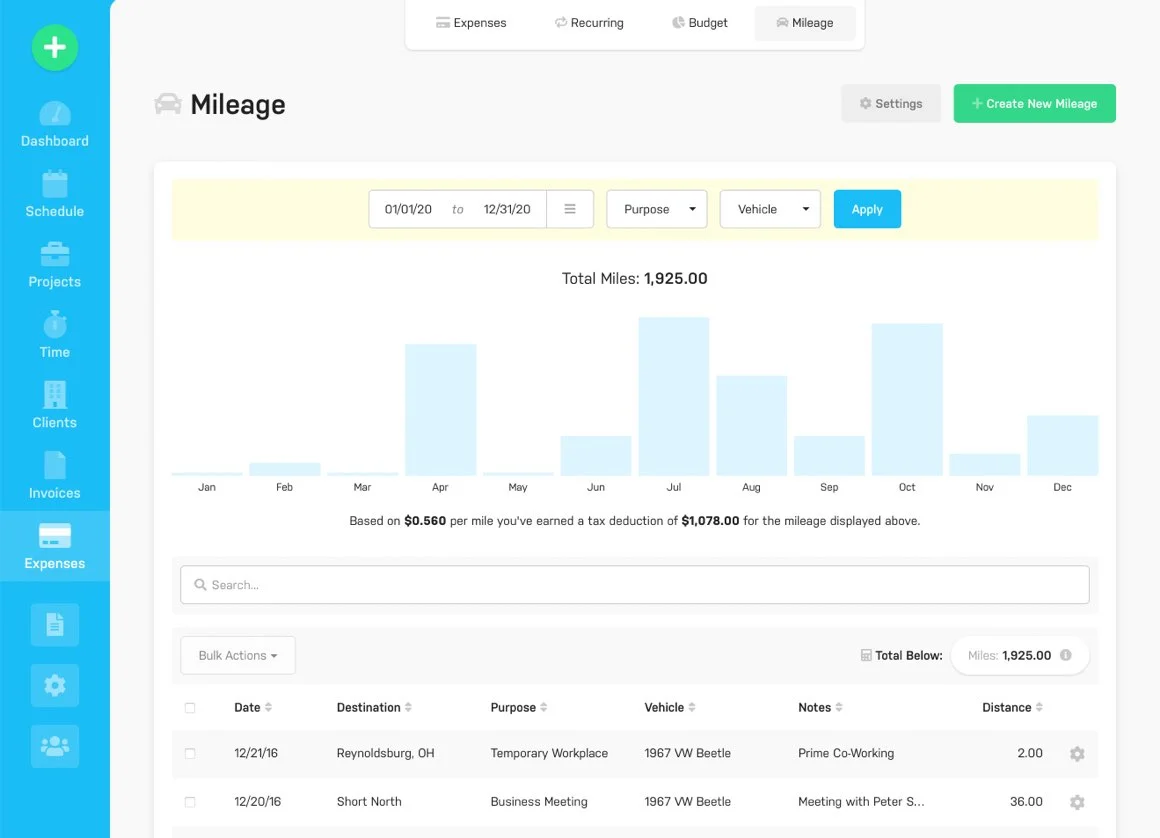
The mileage screen shows your trips over time with a running estimate of your earned tax deduction. At tax time, export a detailed mileage report as PDF or CSV to send to your accountant.
How Much Is This Actually Worth?
Here is a quick reference for what the mileage deduction saves you, assuming a mileage rate of 67 cents and a 30% combined tax rate:
| Annual Business Miles | Deduction Amount | Tax Savings |
|---|---|---|
| 3,000 miles | $2,010 | $603 |
| 5,000 miles | $3,350 | $1,005 |
| 8,000 miles | $5,360 | $1,608 |
| 12,000 miles | $8,040 | $2,412 |
| 15,000 miles | $10,050 | $3,015 |
Even modest driving habits add up to meaningful tax savings. A freelancer who drives 5,000 business miles a year saves over $1,000 in taxes by tracking and deducting those miles.
Tips for Making It a Habit
- Log trips immediately. Keep Harpoon open on your phone or set a reminder to log at the end of each day.
- Use a dedicated trip odometer. Reset it at the start of each business trip so you do not have to calculate distances.
- Review monthly. At the end of each month, review your mileage log for any trips you missed.
- Separate business and personal use. If possible, use one vehicle primarily for business. It simplifies tracking and makes your deduction cleaner.
Further Reading
- Tax Deductible Expenses for Freelancers - mileage is just one of many deductions available to you
- W-9 and 1099 Forms Explained - the tax forms you will encounter
- What to Hand Your Accountant at Tax Time - your mileage report is one of the key documents
- How to Calculate a Yearly Revenue Goal - factor vehicle expenses into your business budget